 
|
John Capurso
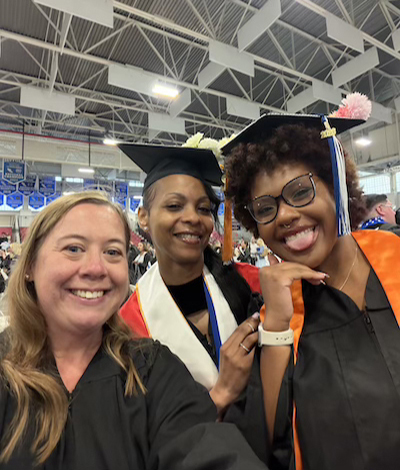
“Being offered a job at my internship site boosted my confidence. A job like this allows me to network and get hands-on experience to help me become a well-equipped social worker. It can open doors to greater opportunities in the future too!” Anaya Lomini graduated last week with her A.S. in Human Services, and she will be transferring to Stony Brook’s Bachelor of Social Work program this fall. In addition to continuing her education in this much needed field, Anaya will be starting work this month with Suffolk County’s Department of Health Division of Community Mental Hygiene Services, a job offer she received through her internship this year. Anaya is grateful to SCCC for this invaluable experience: “Thanks to the human services program, I have had the opportunity to work in an environment where I can apply what I learned in class and get a better understanding of what I am learning.” With a population greater than 12 states, Suffolk County faces no shortage of need in the world of social work and human services. Graduates of our human services program, fortunately, are ready to move directly into the workforce and fill those needs, in no small part thanks to the internship program coordinated by Caitlin Compton-Almo, assistant academic chair and associate professor of human services. Human services majors complete a two-semester practicum involving a supervised internship experience in a local human service agency with 140 field hours in HUS201 and 180 field hours in HUS211. Bringing critical experience for students, this year over 40% of the students in the daytime section of the HUS211 class were offered jobs through their internship placement. “This is the best outcome for students like Anaya,” explained Caitlin. “Internships not only confirm students’ career choice but also help them develop a professional network.” Other direct, immediate benefits include hands-on experience, mentoring from supervisors and discovering the various roles of social workers, client needs and resources. Student interns also learn how to complete reports, utilize databases and apply an ecosystems perspective to assess needs. Caitlin added, “Perhaps most importantly, student interns tell me that they enjoy learning about professionalism and ethical practice as well as feeling appreciated for the work they perform. Many in my HUS211 class also reported experiencing a sense of personal growth over the course of this experience.”
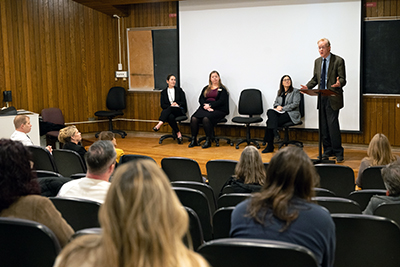
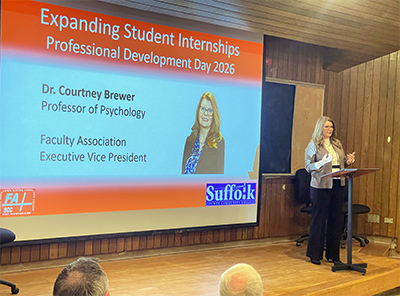
Professional development: For faculty and students Caitlin was among my co-presenters on Professional Development Day (PDD) this year, alongside Courtney Brewer, Trudy Christ, Michael Forte, William Rule and Rachel Schmidt. We’re proud that our PDD workshop also featured Suffolk County Comptroller John Kennedy and Chief Auditor Tim Smith. We are told that this is the first time in college history that a local elected official co-presented at PDD alongside faculty. Comptroller Kennedy spoke of the need for students to have improved liberal arts skill sets such as stronger written and spoken communication competencies in addition to discipline-specific knowledge. Mr. Smith discussed the success of the collaboration between the Office of the Comptroller and the college’s accounting interns over the past few years. Faculty presenters focused on the need for students to become professionally developed through internships like the ones Caitlin oversees because of the extensive benefits that set them apart from thousands of other graduates. Trudy Christ, for example, spoke about how internships in her discipline of interior design “create a bridge between academia and experience that cannot be replicated within the classroom.” During her PDD presentation, Trudy explained
Communication studies adjunct Suzanne Rosenthal was in our PDD audience because she comes to SCCC with a background in corporate human resources and talent recruitment, specifically overseeing early-career hiring, internships and training programs across creative, corporate and tech teams. Suzanne hoped to learn more about how internships work at the college because, she said, “I’ve seen firsthand how valuable experiential learning is for student success. Internships help students clarify interests, build confidence and understand how their coursework translates into real careers.” Another PDD participant was Professor of Political Science Nick Giordano who strongly encourages students as they independently pursue internships, including in the Suffolk County Legislature. “It’s not necessarily about the internship itself, it’s about the people they meet,” Nick said. He’s the sole full-time political science professor at the college and has no structured internship program, but he assists students as they seek internship opportunities. Nick added
County-college connections My accounting students who have done internships in Comptroller Kennedy’s office have benefitted greatly from the experience and speak highly of the mentorship provided by Tim Smith and his staff. As Caitlin and Nick note above, students also benefit from doing internships with the Suffolk County Legislature, Suffolk County Department of Health and other county offices. Associate Professor of Marine Biology Kellie McCartin has helped dozens of students benefit as interns for the alewife fish ladder research project she coordinates at the college, which is funded in part by Suffolk County. Like Caitlin, Trudy is happy to see so many students receive job offers as a result of the internships that are structured into her interior design curriculum. Even better, she noted, “Many students have been hired after completing their internship and continue to act as ambassadors for SCCC and the interior design program, reaching back to offer employment opportunities for other students and graduates. Some of our graduates open their own design companies and reach back to the next generation of designers, extending a hand into the professional world through hiring interns from the same program they graduated from.” Plans to expand Given the reciprocal benefits between our student internship opportunities and public and private organizations across the county, both FA and Guild members are working diligently to expand student internship programs in any way they can in spite of limited resources. Assistant Professor of Business Administration Kristin Cadolino is in conversations to bring BUS150: Cooperative Education in Business to the Eastern Campus. Kristin had taught sections of BUS150 on the Ammerman Campus and created a virtual internship program during Covid, which garnered coverage in Newsday. On the Grant Campus, Assistant Academic Chair and Associate Professor of Marine Biology Camilo Salazar is currently developing plans to expand internship opportunities for SCCC students in biology. “These will be across various Suffolk County government departments, including Comptroller Kennedy’s office,” Camilo asserted. He recently submitted a draft of his proposal to administration and is excited to see where it will lead. Camilo’s counterparts in marine biology at Ammerman, Marianne McNamara and Jean Anastasia, used to serve as mentors for students interning at the Long Island Aquarium, Riverhead Foundation or other independent locations such as the Holtsville Ecology Site and local veterinarians. However, internship courses are not built directly into the curriculum as they are in human services, interior design, business and other majors. “The process, then, was challenging because it was run as an independent study,” Marianne explained, and they continue to actively promote internship opportunities by sharing them via email, Brightspace and posters on campus. However, she asserted, “having dedicated credits linked specifically to a marine science internship would be extremely helpful to not only provide appropriate acknowledgment but also encourage involvement.” This kind of institutional commitment to the internship experience helps build what Trudy so aptly called the “bridge between academia and experience” that can be critical to the success of students, just as it did for Anaya. |