 
|
Dante Morelli
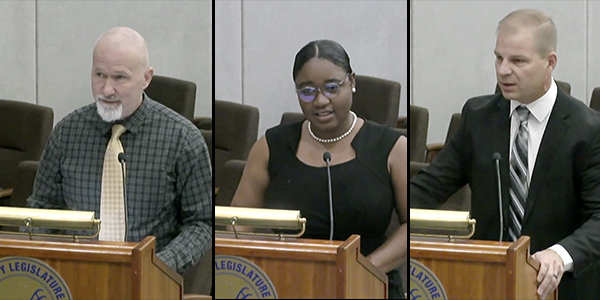
“This internship was the best experience of my time as a student,” recent graduate Nancy Lorme proudly asserted, referring to the accounting internship she had completed in Suffolk County Comptroller John Kennedy’s office. This is remarkable, coming from a May 2025 student Commencement speaker (see Commencement video 5:15 to 5:25) who had received the SUNY Chancellor’s Award for Student Excellence, PTK All-State Scholar and Coca-Cola Bronze Scholar Awards and who had been president of the PTK Honor Society and Rotaract Community Service Club, a campus peer mentor, member of the Honors Program and member of the Student Conduct Board. Nancy, a mom of three, had been fully involved in campus life—and still says the internship organized by Assistant Professor of Accounting John Capurso was her best experience during her time here. Nancy was speaking before the Suffolk County Legislature’s Education and Diversity Committee meeting on August 27. As she explained to the legislators,
Educators meet legislators The goal of our presentation to this legislative committee was to emphasize how meaningful such internship opportunities are for SCCC students and to encourage collaboration to develop and expand the college’s internship programs. At last count, we identified around 15 distinct academic curricula that include internship or cooperative education courses, and approximately 14 FA members and seven Guild members who teach these on a fairly regular basis. For this introductory meeting, I had invited the following FA members to address the committee with me:
The week before our presentation, at the August 21 SCCC Board of Trustees meeting (see video :45 to 1:50), Tom Lupo from Comptroller John Kennedy’s office spoke during public comment about the great work our student interns do in his office. I’ve had similar conversations with Comptroller Kennedy when I see him at events throughout the year; he always has great praise, respect and admiration for interns like Nancy. We deeply appreciate Comptroller Kennedy’s advocacy for the college’s internship program, and Nancy knows better than most the invaluable benefits that come from hands-on experience in the workplace. Thank you to Nancy for taking the time to present alongside our FA members. FA members speak about student success John Capurso, because he teaches BUS150, has the most experience working directly with Comptroller Kennedy’s office. John talked about how internships are not just an extension of what students learn in the classroom but also “provide students with firsthand professional experience and, perhaps most importantly, the belief that they have real promise and potential as future professionals—that they are capable of success in a previously unfamiliar environment.”
For the students who do land these valuable internships, it can lead to more than just workplace skills and experience, it can lead to a job. Michael Forte is college assistant director of web services but serves as an FA adjunct when he teaches CST288: Cooperative Education/Internships for Computing Technology. Michael spoke with pride about the results of his efforts to place the right students into the right internship sites:
We know the college values workforce development in addition to preparing students for academic transfer. Thus, Courtney, Cynthia and I all addressed how internships help students develop the “soft skills” that are sorely needed in the workplace. The front cover of the January 26, 2024, Newsday displayed the headline “Poll of LI CEOs: Job Applicants Not Qualified,” for an article noting that seven out of 10 CEOs said applicants did not seem career ready as a result of poor writing and communication skills. This was just one of the concerns they expressed about current job applicants. During her presentation, Cynthia relayed how Comptroller Kennedy had told her after our May Commencement that he’d love to see the college’s internship programs further developed because, he said, “Student interns need not only their discipline-specific skills (accounting, taxation, finance, audit) but also more training in written communication and the soft skills needed to succeed in a business setting.” Growing and expanding I am so proud of the FA members who joined me in speaking to our elected legislators. We are eager to see how we might collaborate with the college, county and Legislature to enhance our students’ internship opportunities. When we screened Legislator Steve Flotteron over the summer, he had offered one idea of having history majors from the college doing internships involving archival work in county historical societies. This kind of shared idea generation—between elected officials and our members who are doing this work firsthand—is what we would love to see grow. This is so important to the future of Suffolk County. Internships provide critical support to the places that enjoy working with our students and, as Nancy had shared, they are also deeply meaningful to students’ professional development. In her introduction, Courtney provided important context for the overall presentation:
Our elected county leaders are asking for more of our student interns. They value the work and the energy they bring to their assigned internship. Let’s continue to grow the program and keep these important programs expanding. |