 
|
Cynthia Eaton
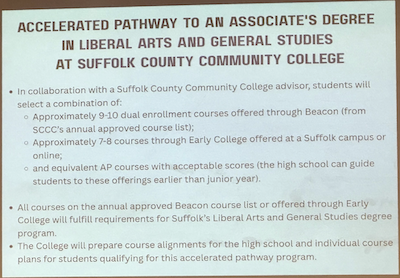
“What we need right now is for cooler heads to prevail and for people to proceed with caution given the complicated political situation we’re in.” If I had a dollar for every time I said this over the past month. As you can see from Dante’s cover story and Courtney’s article, a growing number of people are profoundly upset about a presentation during the March 10 Islip High School Board of Education (BOE) meeting that involves Beacon, the college’s dual enrollment program. I wasn’t at that BOE presentation, but I’ve watched the video which you can view on the Islip BOE YouTube channel (Beacon presentation is in the first half) or read in this edited YouTube transcript. The presenter was describing a program by which their students could earn an SCCC associate’s degree while still in high school. The presentation illustrated how this might be done, for example, if students take five AP courses in ninth grade, complete multiple Beacon courses (taught by teachers in their high school) and enroll in Early College classes taken at SCCC during the summers or even online during wintersessions. It included a fairly detailed curriculum map for parents and their children to see how this might be accomplished. In the month since, I’ve been deeply involved in conversations about that presentation with colleagues across the college as well as people outside the college. These conversations take place both in my role as an FA officer and as a member of the Eastern Congress Executive Council. Being union and being governance for me is a both/and, not an either/or, so I work hard to look at situations from my perspectives as an elected union officer for over two decades, an elected campus governance representative, a professor for 28 years and simply as a parent and citizen who’s concerned about the future of our county, state and nation. Faster, better, cheaper: This is not McDonald’s
When I first watched the video, some of the language bothered me but did not surprise me: Acceleration. High school hustle. Jump. Education pays. High costs. Tens of thousands of dollars. Fifteen years ago, I had been interviewed on an NPR affiliate about online education opposite Anya Kamenetz and I had said then that “faster, better, cheaper” is a great mantra if you’re in the fast-food business but not if you’re in education. In a September 2011 article in The WORD, I wrote of Kamenetz’s “DIY U” book,
Interestingly, in the years since, Kamenetz became a parent and her latest book promotion strikes a different tone: “An NPR education reporter shows how the last true social safety net—the public school system—was decimated by the pandemic, and how years of short-sighted political decisions have failed to put our children first.” Funny how perspectives change upon becoming a parent. The Islip BOE video echoes some of the faster, better, cheaper jargon that was prominent in Kamenetz’s “edupunk” days of promoting “do-it-yourself university.” That was then, this is now Then, the concern was focused on online education and MOOCs. Now, the concern is more focused on dual enrollment, on high school students taking Beacon classes, to accelerate their way to a college degree (read Dante’s article for some basics on Beacon). I understand why some colleagues perceive this to be an existential crisis. And while we’ve been through other trends and shifts that also felt like existential crises, certain factors make our current political moment more disconcerting. First, we are in a different historical and cultural context. Student enrollment nationwide has been in broad decline since peaking in 2011-12, and there’s the demographic cliff caused by an historic decline in birthrates which has meant fewer traditional-aged students in high school and college—an issue we’ll continue to face in the coming decades. In addition, economic pressures from a half century of declining state support for public colleges have led to rising tuition and fees along with associated increases in student loan debt. Combine these factors with austerity approaches, and we’ve seen a number of college closures and mergers (see lists from 2025, 2024, 2023), program cuts, layoffs and retrenchment and lost jobs. Private four-year colleges have faced the most closures, but public college and university systems have not been spared. By 2021, the University System of Georgia had consolidated 35 institutions into 26. In 2022 Connecticut merged 12 community colleges into a single institution with multiple branches and Vermont merged three campuses into Vermont State University. In 2024 Wisconsin merged 13 community colleges in with its four-year colleges. In 2025 Penn State closed seven of its satellite campuses. There’s significant pressure, including here in New York, to learn to cooperate rather than compete, or to share as Lee Gardner puts it in a March 2026 issue of The Chronicle of Higher Ed. Political pressures have also chipped away at the general consensus America once held that education is necessarily a public good and that college is something to be valued not only for more gainful employment but also for a healthier society. Add to this the technological disruptions of the past few decades, from online education to pandemic-induced remote learning to artificial intelligence (AI) becoming widely accessible. Many of our traditional-aged students grew up in an age where they’ve become accustomed to individualized, customized and on-demand services—think of Siri and Alexa, Netflix and Amazon, Uber and Door Dash—and are more likely to expect speed, efficiency and little friction along the way so faster, better, cheaper might feel “right” to them. Pressuring kids to solve structural problems As a nation we’ve set up a system where college has grown inordinately expensive in an historical period during which—as this Federal Reserve distribution chart makes plain—wealth inequality has also increased dramatically since 1989. The wealth gap contributes to worsened college completion rates for poor and working-class students, as they need to balance work, family obligations, coursework and self-care. Rather than address the structural problems contributing to increasing college costs, however, we collectively pressured students and their families to take on student loans, as shown by the Education Data Initiative. A few decades of the student loan debt crisis predictably led to more students and families questioning the value of a college education.
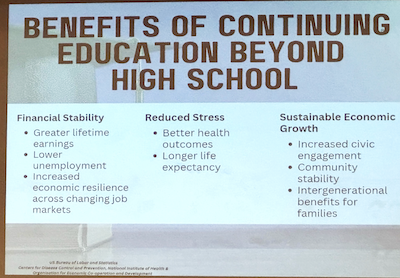
The value of a college education was central to the Islip BOE presentation, and it feels like we are again pressuring individual students to solve structural problems. It began with a review of statistics on the benefits of a college degree, with highlights including improved financial stability, reduced stress, improved health outcomes, a longer lifespan and the ability to better afford to stay on Long Island. As the superintendent ticked through the list of statistics for each of these, you can imagine the parents in the audience would want their children to earn more, be less likely to become unemployed, stay on Long Island, be healthy and live long lives. Flawed logic There’s an obvious flaw in the logic, however. These statistics are valid, but most if not all are predicated on studies of adults who enjoyed four years of high school followed by at least two if not four years of college. We do not know if such statistics hold true for high school students who sort of speed run their college education in the manner suggested in this “accelerated pathway.” Next came datasets focused on college completion rates, which aren’t news to us in higher education. It often takes students more than two years to complete an associate’s degree and more than four years to complete a bachelor’s degree. This is predominantly due to historical shifts (see wealth gap data linked above) that makes students need to work their way through college.
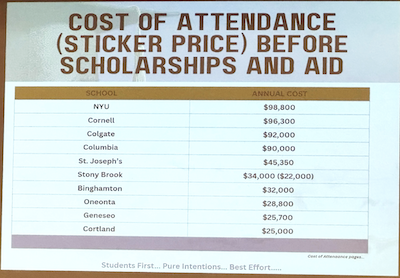
Then the presentation turned to college costs with the slide shown at right. The logic of this part of the presentation is also tricky because about half of all bachelor’s degree holders have no debt and the majority of students do not pay the full sticker price listed by colleges and universities. For example, we know that “SUNY grads have less student debt on average than their peers across the country—and half of them have no debt at all.” Further, as acknowledged in the presentation, there is an important difference between college sticker prices and what families actually pay as a result of tuition discounting. If the sticker price is $32,000, that’s not paid by the majority of students, only those who get zero financial aid, i.e., the wealthiest of students. As the National Association of College and University Business Officers (NACUBO) explains, even private colleges and universities are offering record amounts of financial aid. So while this BOE presentation leaned heavily on the benefits of a college degree and the exorbitant costs of college, both of which we are fully cognizant of, we also believe the information should be presented in a clear and fair manner to local families. FA member concerns After articulating that high school students significantly benefit from pursuing higher education but that college has become very expensive—“and that’s daunting and it forces many families to say college education may not be for us”—the presenter turned to what he called a “healthier alternative or maybe a faster alternative”:
This is where our FA members become concerned. They understand better than most the value of a college education, not only for improved employment prospects but also for improved quality of life. They understand that a participatory democracy works best with a highly educated citizenry. Our members aren’t unaware of the costs of attending college; we’ve been advising students, leading campus clubs and activities, setting up internships, writing letters of recommendation for scholarships and transfer applications, adopting open-source alternatives to expensive textbooks, donating to the SCCC Foundation and more for decades. Our members are also concerned about the quality of Beacon classes. They are concerned about reports they are hearing of some high schools offering combined Advanced Placement and Beacon classes, some Beacon teachers refusing to follow the SCCC syllabus and some Beacon teachers refusing to interact with their assigned liaisons. None of these things should be happening since the local districts sign a contract with the college indicating that these are basic elements of the program. Courtney’s article discusses how our members also see more students come to us underprepared, or eager to outsource their thinking to artificial intelligence or carrying inappropriate expectations for the mental and intellectual challenges of a college course, so they are not convinced that earning a college degree simultaneous with your high school diploma is a smart solution that can really help. Our members saw this note—“Bottom line is, investing in education is an investment in your long-term economic security and public health and also in quality of not only your life but the life of the community where you live”—and immediately understood that the investment is one of money but also of time and thought and reflection and growth. You can’t speed run that. The FA position
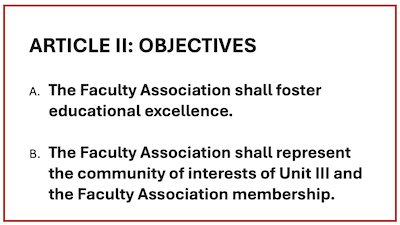
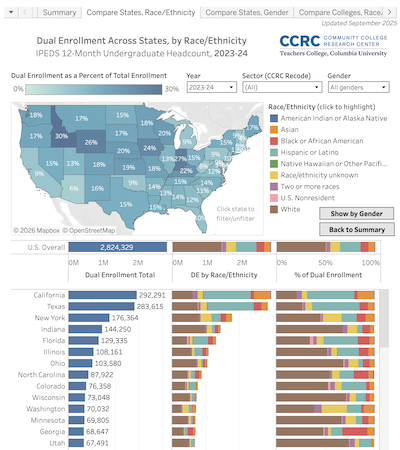
The FA knows that dual enrollment programs are very popular across the nation, especially in the South and Midwest, in part because of how they can help close equity gaps, and that as of 2023-24 New York has the third highest number of dual-enrolled students in the country. (If you’re looking for a good primer for dual enrollment, visit Columbia University’s Community College Research Center.) We are not opposed to the Beacon program. About two dozen of our members signed up as faculty liaisons to help ensure it works well because they want it to be as academically sound as possible. We care deeply about fostering educational excellence, which is our primary purpose as outlined in our FA Constitution. As a union, we understand the contractual provisions that undergird Beacon and the multiple stakeholders involved that shape its direction. We also get the complicated political situation we’re in and we’re not unaccustomed to negotiating the sometimes competing interests of administration vs. faculty. For example, we know that some people have questions about the Beacon Liaison Handbook, but that was revised through a labor-management committee which means it is negotiated language. Does it have everything the FA wanted it to have? No. Does it have everything administration wanted it to have? No. But that’s what happens in the process of collective bargaining. It’s collective bargaining just like shared governance is shared. We hear our members’ concerns. We will do all we can to ensure that cooler heads prevail. And we will continue to negotiate in good faith with administration as we work toward positive solutions that protect educational excellence. |