| |
 |
| |
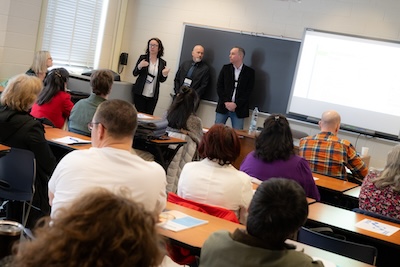
From left, Marta Szpak, John Capurso and Jared Dowd offered a presentation to a standing-room-only crowd on Professional Development Day on how to better achieve regular and substantive interaction in distance education classes. (photo by Victoria Pendzick) |
| |
|
John Capurso, Jared Dowd and Marta Szpak faced a packed room on February 11. It was Professional Development Day (PDD), and their workshop was standing-room-only packed with faculty who wanted specific, concrete advice about how to better achieve regular and substantive interaction (RSI) in their distance education classes.
Boy, did this trio deliver!
As the college continues to face enrollment, persistence and retention concerns, it is more critical than ever for us to come together and share teaching techniques that help students succeed, such as the ones in the JEDI Institute Colleagues Share page. That’s why I asked these three colleagues to collaborate on this PDD workshop—because they know learning is about more than reading textbook chapters and responding to auto-graded quizzes. Consider how Albert Einstein is attributed as having responded to the question “what is the speed of sound?”
I don’t know. I don’t burden my memory with such facts that I can easily find in any textbook. It is not so very important for a person to learn facts. For that he does not really need a college. He can learn them from books. The value of an education in a liberal arts college is not the learning of many facts but the training of the mind to think something that cannot be learned from textbooks.
I am grateful to John, Jared and Marta for sharing their smart suggestions on ways to achieve RSI. My contribution was simply a one-page handout with nine ideas for better RSI in your classes; the rest was all from this power trio. Because this is a lengthy article filled with their smart suggestions, you can jump to any one specific suggestion using the links below, but I strongly suggest reading them all, as they no doubt will help spark your own good ideas and approaches for your own classes.
- John Capurso, Accounting and Business
- Engaging students in better online discussions through challenge questions
- Using MS Bookings to schedule synchronous student sessions
- Jared Dowd, Human Services and Healthcare Studies
- Applying the intrusive advising model in the classroom
- Using the Remind app
- Hosting a professional Instagram page
- Giving personalized feedback on assignments using a tablet
- Achieving active discussion forums in math: General class questions, homework help and weekly forum
John Capurso, Assistant Professor of Business/Accounting
John learned early on, working in his family’s third generation business, that success is built on establishing relationships. He honed the practice of bringing individualized attention to customers while later operating his own businesses, including bringing individualized attention to clients as a CPA, leading to his highly individualized attention to students here at SCCC. “Student success is our success. Creating a sense of connection early on,” John says, “and showing students that I care about their individual progress is critical, whether I am teaching on campus or online.” Knowing John’s outsized work ethic and dedication to student success made him a logical choice for our workshop, for which John focused on two elements of his effective pedagogy.
| |
 |
| |
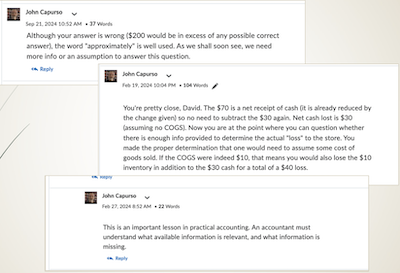
John Capurso integrates carefully structured challenge questions into his online class discussion boards for his students to work through, periodically replying with encouraging hints and suggestions to help them resolve the challenge. |
| |
|
Engaging students in better online discussions through challenge questions
To help students learn how accounting principles apply to real-life situations, John periodically posts guided discussion prompts in his online discussion board. Using the concepts he has covered, John presents hypotheticals, then asks students how they would approach them from an accounting perspective, step by step.
John checks the board daily and replies to student responses with a hint about a factor they might have overlooked or a different perspective to consider, always with a positive, encouraging tone. John gave an example of a recent discussion:
A man steals a $100 bill from a shop. He then uses that $100 bill to buy $70 worth of goods. The shop owner hands him back $30 in change. How much money did the shop owner lose?
This seemingly straightforward question is more problematic than students expect (it does not contain enough information to give a definite answer). While students confidently offer their answers, John points out flaws in their process and gently guides them to reconsider. John estimates that only one in 150 students will answer this question correctly in their opening post, but students overwhelmingly gain an understanding of the underlying concepts in a far more effective way when they have that “light bulb” moment.
John also creates graded one-on-one student/professor discussions by using Brightspace groups and setting the group size to one student and the threads set to private. In these discussions (seen only by the student and instructor), John requires students to check in for credit on topics of the student’s choice including review of present and past assignments, grading inquiries, course feedback, education and career advice or any other questions the student may have. This gives John a further opportunity to connect with students individually and ensure student participation in the RSI process.
| |
 |
| |
John Capurso allows students to book themselves into extra help Zoom sessions with him using MS Bookings. This lightens his workload because it avoids the back-and-forth of scheduling and a quick conversation with a student can be far more productive and effective. |
| |
|
Using MS Bookings to schedule synchronous student sessions
John is a prolific user of Microsoft Bookings to manage student meetings. We all have access to Bookings in our Office 365 accounts, and the program enables students and colleagues to book appointments or meetings with you.
Because John also teaches the BUS150 internship course, he is constantly juggling students’ complex schedules against his own. To make things easier, he sets up his office hours and additional after-hours availability in Bookings and shares the link with students. Students can click into John’s Bookings calendar and fill in their name in any time slot he has designated as available.
In this way, John puts the agency back on students to actively make the appointment and expects them to keep it. These are brief 5-25 minute Zoom chats in which he can assuage a concern, offer some guidance, fix a tech issue and help students move forward. More importantly, it allows John to give his full, undivided attention to that student in that moment, which brings him the kind of individualized attention in an online section that he craves.
Jared Dowd, Associate Professor, Financial Aid
Jared has been in his full-time financial aid counseling role since 2015 and worked as an adjunct member for four years prior. In this time, he’s come to realize that students are not quick to seek out college employees, especially their professors, for help. When students have questions, they go to their friends first. It feels safer and easier to them, and that’s fine except their friends don’t have the knowledge we employees have. Thus, Jared works hard in his online classes to regularly interact with students through the intrusive advising model and by connecting with them on multiple platforms.
Applying the intrusive advising model in the classroom
While many of us know Jared as a financial aid whiz at the Grant Campus, you may not know that he also teaches HUS101 Introduction to Human Services and HSC114 Group Dynamics. Jared makes his online classes RSI intensive by applying the intrusive advising model in counseling to the academic realm. According to the National Academic Advising Association (NACADA), intrusive advising is a proactive approach to supporting students’ academic success by building relationships, actively reaching out and using personalized communication. It involves anticipating issues, concerns, roadblocks—anything that could potentially get in the way of a student interacting in the course and being successful. Students also benefit from his staggered assignment deadlines, collaborative group work and synchronous Zoom sessions, all of which are presented in a scaffolded way to lead students to becoming more self-regulated.
Using the Remind app
During our PDD workshop, Jared said, “I encourage students in my courses to download the Remind app and sign up for my text reminders. Remind is a free one-directional text message application that lets faculty communicate with students in real time. Students tend to be familiar with it already, since many used it in high school. Yes, we can use Brightspace alert features, but we all know that students are constantly on their phones, so why not reach them where they live?”
Signing up for Remind messages is not mandatory, but most of Jared’s students do and, he said, it has led to a significant decrease in missed assignments since he implemented it a decade ago. It is easy to use and it’s just one more way for Jared to stay connected with his online students, to keep his course at the forefront of their attention in their busy lives and let them know that he’s paying attention to and cares about their success.
| |
 |
| |
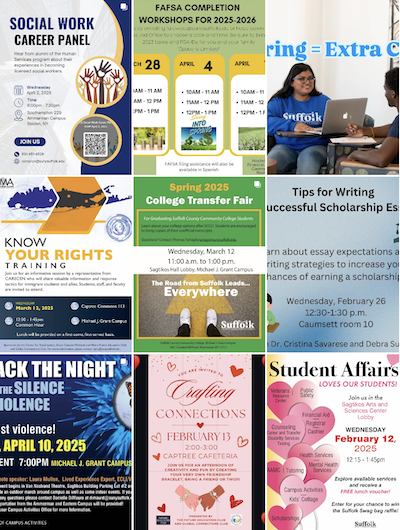
This screenshot of Professor Dowd’s Instagram page shows how he posts a variety of academic support resources and campus events for students. |
| |
|
Hosting a professional Instagram page
In March 2020, before going remote, Jared was talking with students about ways to keep in touch and said, “within two minutes, they had created an Instagram page that everyone was a part of.” Taking their lead, Jared then created his own Professor Dowd Instagram account where he regularly posts about activities and events related to his students’ majors. Research has long shown that retention and student success rates improve when students are involved in campus clubs and activities, so Jared is eager to encourage this.
“Now, I know that RSI refers to what we do within our distance ed courses, but this is one supplemental way that I support students and keep my coursework fresh in their minds,” Jared explained, adding that the college has a specific social media policy and request form that faculty should be familiar with.
Marta Szpak, Associate Professor, Mathematics
As coordinator of the math learning center at Eastern, Marta has long been deeply attuned to giving students individualized attention, particularly because there is no doubt that students are arriving on campus less prepared in math than ever. Teaching statistics online, Marta knows the best way to support student success is through robust RSI. Like both John and Jared, Marta had logged four years as an adjunct faculty before being hired full time. In her 12 years at SCCC, through trial and error, she has developed two key ways to help her online math students have the absolute best chance of mastering her course material.
| |
 |
| |
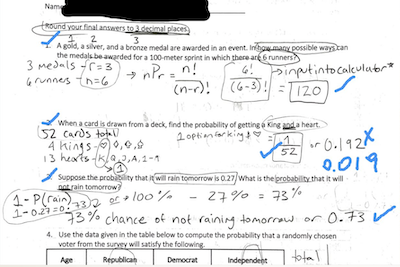
Marta Szpak (Mathematics) taught workshop participants how she uses her iPad to provide her handwritten feedback (in blue ink) on students’ handwritten math homework. |
| |
 |
| |
|
Giving personalized feedback on assignments using a tablet
During our February PDD workshop, Marta explained why she requires students to do their homework by hand rather than solely rely on auto-graded textbook problems. Then she demonstrated how she carefully teaches her students to take a photo of their handwritten homework and upload it to Brightspace—and showed how she uses her tablet to
give students her own handwritten feedback on those assignments.
“I use an OER statistics textbook,” Marta explained, “where students complete assignments and it shows them immediately if their response is correct or incorrect so they can try again for practice.” The textbook is great, Marta said, but the focus on the correctness of the answer is insufficient to help students build the skills needed for mastery of math concepts.
Therefore, she requires that students
hand write their solutions, take a photo and upload it to the Brightspace assignments area. This is all carefully taught first thing in the semester. Then, Marta downloads their work onto her tablet for review and uses the stylus to show what they are doing well and where they have made, say, a calculation error. That gets re-uploaded for the student to access.
This may sound labor intensive, but Marta showed it is really not burdensome once you learn how. “A student might understand the overall concept but arrive at an incorrect answer due to a minor miscalculation or misstep in the process, so this way I can show precisely where they went wrong and award partial credit.” Doing so means a lot to students because it is far more encouraging than simply getting a 0 on that problem.
This approach also personalizes the learning experience since students literally can see Marta’s individualized attention to their efforts, plus it demonstrates that she values their effort and growth. This is mission critical in math since so much of the material is sequential and we don’t want students to simply give up.
Achieving active discussion forums in math: General class questions, homework help and weekly forum
Building active discussion forums in an online mathematics class? Yes, says Marta. Now, I have personally heard faculty in STEM disciplines ask what would be the purpose of any use of the discussion board since all faculty really care about is whether students know the content. Those faculty forget that education is about more than mastery of course content and that students benefit greatly from a balance of student-instructor, student-content and student-student interaction in an online class. Students do not want to feel like they are in a classroom of one, and students do not want to feel like they are teaching themselves the material.
Marta’s got this mastered. She described the three ways she uses the discussion board:
- General class discussion — This is a general discussion topic where students can post their questions about class policies or procedures or any non-mathematical concerns they have. This is where students will ask how to do things in Brightspace or things like due dates or the late submission policy, etc.
- Homework help — These are open discussion topics, one per module, in which students can post a question they have about any of the homework assignments and ask classmates for help. Marta monitors these topics and responds in a timely fashion if a classmate hasn’t already done so.
- Weekly forum — Each week, Marta asks students to post responses to a specific prompt that she provides, some related to class and some not. “I strategically alternate these throughout the semester,” Marta says, “so for instance during midterm exam time I am purposefully asking a light, fun question rather than a more serious, thought-provoking one.”
Some of Marta’s non class-related prompts:
- Class introduction icebreaker activity
- Two truths and a lie
- What is the best piece of advice you’ve ever been given?
Some of Marta’s online class-related prompts:
- What is the most challenging homework assignment we’ve had so far this semester?
- What is your best tip for avoiding distractions when doing coursework at home?
- What is the biggest difference between learning online and learning in person?
- As the end of this semester approaches, what questions do you have regarding our class, final grades and/or the grading process?
We encourage faculty wanting to try any of the above to contact these three presenters. I also created this handout with a list of ways to achieve RSI for the workshop as well. Finally, you absolutely should contact the Center for Teaching and Learning to get more ideas and specific assistance in any of the above or other ways to improve RSI in your own distance education classes.
|