April 2026
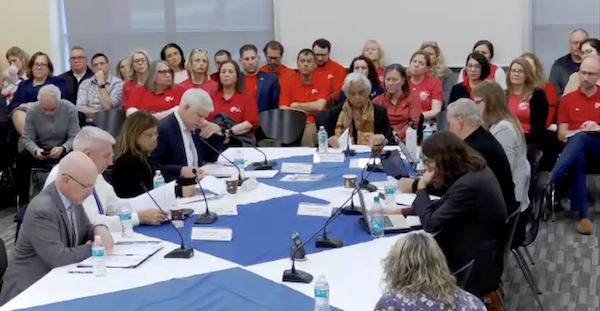
As many of us are aware, the college has been participating in dual enrollment with Suffolk County high schools for the last two decades. As noted in Dante’s cover story, there is a provision in the FA contract that allows for participation in the dual enrollment Beacon program (referred to as dual credit in the contract). Dante’s story also explains how there are a few conditions placed on the college in this contractual provision, but the program was never intended to be what we are watching it evolve into at this time. Initially, back when it was called Excelsior, the program served a relatively small number of high-achieving students who had the ability and motivation to complete some college-level coursework while in high school. Today, however, there are over 5,000 students enrolled in Beacon courses across every high school in Suffolk County—and there are serious questions being raised about Beacon students’ readiness as well as the “college-level” experience they are receiving in these classes. We know there are good reasons for the college to offer Beacon classes, including legitimate concerns about increased equity in access to higher education for underrepresented students. Participation in dual enrollment also has the potential to save families thousands of dollars when their kids earn college credit in high school and can reduce the amount of financial aid funds used, saving them for later on. For the college, Beacon students also boost student enrollment numbers and bring a significant amount of money into the operating budget. However, on March 10, Dante and I attended the Islip Public Schools Board of Education (BOE) meeting to learn more about a pilot program that takes expansion of Beacon to an entirely different level. The proposal laid out before us involved encouraging high school students to “hustle” during high school to earn an associate’s degree at the same time they are completing their high school diploma. “High school hustle,” the students were told, “equals college muscle.” After reviewing with the parents and students in the audience an overview of how expensive college is and the numerous benefits of a college degree, the focus at the Islip BOE meeting shifted to this idea that if students work really, really hard, their “high school hustle equals college muscle” and these students will be saving their families tens of thousands of dollars. Who doesn’t want to save tens of thousands of dollars? As a psychology professor, I am acutely aware of the other issues we have been working so hard to address as educators, primarily student mental health issues and the proliferation of cheating via the use of artificial intelligence (AI). Those issues seem to have been taken out of the conversations about expanding Beacon to include students completing the requirements for a Liberal Arts & Sciences: General Studies degree while in high school. This seems a perfect storm for some disastrous outcomes not just for the college and its future but for the very students we are supposed to be serving. Social and emotional development do not seem to have any place in this conversation, and yet they are incredibly important to adolescent development. There are a multitude of developmental tasks that first and second year college students benefit from experiencing, including the final stages of identity formation, exploration of a new and larger social experience, increased ability to advocate for themselves, opportunities to learn and practice self-discipline and of course exposure to a number of fields of study they perhaps never realized would interest them or even existed. Having students complete their first two years of college without affording them an actual college experience, even at a commuter school like SCCC, is inappropriate and a disservice to them. Students are already under tremendous pressure to achieve; families in many districts across Long Island in particular are heavily invested in the notion that when kids graduate high school, they should go to college. There is a robust sports culture among Long Island high schools, where students often vie for athletic scholarships that most will not receive. So, when the notion of reduced cost and basically guaranteed college credit is offered, it is going to be very appealing to local families. However, placing such pressure on adolescents, especially during the teen years, to work even harder, to “hustle,” so they can save their families tens of thousands of dollars surely will exacerbate the current mental health crisis. The accelerated degree program begins targeting students in the eighth grade, telling them they will need to take several AP courses in ninth grade. In eighth grade I was 13 years old and I was not thinking about college. My mind was focused on navigating the halls of the much larger high school without getting lost, figuring out how I could wear makeup to school without getting caught and the dreaded question on my mind and my friend’s minds, “What happens if I can’t get my locker open?” Developmentally appropriate education Do we really believe that 13- and 14-year-olds are developmentally ready to take four or five AP courses in ninth grade and to sit in college classrooms for summer courses alongside students in their 20s and 30s? We see at SCCC that a sizable portion of traditional-aged students in our classes now are not developmentally prepared for the challenges of handling a disappointing grade, nor do they seem to understand that the grade they want requires more than simply being in attendance each week. Do we really believe students that young are prepared to navigate a fully online environment which requires high levels of self-regulation? The psychological research makes clear they are not. How likely is it that they will be the ones actually completing the online assignments? We also are seeing college students who go on to upper-division courses only to discover they are woefully unprepared to handle the curriculum and, in many cases, life as a college student in general. Do we also really believe that 19-year-olds are ready to enter the workforce or graduate-level education with their newly earned bachelor’s degree in hand? We heard a few times during the presentation that this accelerated pathway will only work for a few students but there was also pressure to get as many students to “partner” with the school as possible to fill those classes. Academic advisement Then there is the advising piece. General Studies students without proper advising sometimes find that they have taken courses that don’t apply to their future degree program, causing them to have to take unnecessary courses to fill gaps which contributes to delayed degree completion. Again, in eighth and ninth grades, I had no idea what my future career would be and asking me that at age 13—in order to plan my college courses over the next four years so that I could save my family thousands of dollars to prevent them from going to into massive debt just to send me to college—absolutely would have stressed me out. Why are we rushing students through both their high school as well as their first college experience? Is it even possible to participate in extracurricular activities while taking five AP courses? Colleges today are looking for well-rounded students who have demonstrated academic achievement as well as community service and significant extracurricular involvement. How does spending every summer of high school taking college courses sound? Grades alone are not the ticket to entrance into a great four-year school, yet students are getting the message that the grade is the goal, not the actual education. This mindset contributes to rampant use of AI by students to avoid taking their time and doing the work of reading, writing and understanding their course content. Many students view AI as a fast and easy way to the A without having to do the work, and it has become normalized for those who see it as a necessity to get through their courses. The worst message to come from educators is that the only thing that matters is getting those grades and getting them fast. We also heard in the Islip BOE presentation the possibility of our SCCC counselors training high school guidance counselors to properly advise students, or working alongside them in some fashion. As a union leader, I can tell you that proposal is going to need a lot more conversation. The Beacon program at this moment in time is plagued by some serious problems that compromise its integrity and by extension the integrity of the college. Please, let’s work on recalibrating the program to address issues of rigor and developmentally appropriate practices before we entice families with false promises of a “college-level education” while in high school. Everyone involved in this equation deserves better than this, but none more than the students we are harming by not correcting what we already know is wrong. |