November 2025
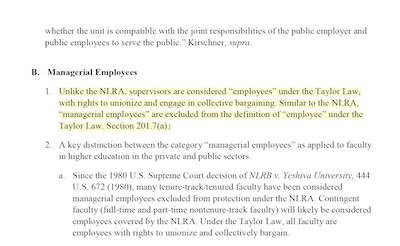
It’s sabbatical season. Our contract indicates that sabbatical applications are due on October 15 and that a committee of three administrators and three FA members will vote on applications. Co-chaired by nonvoting members Vice President of Academic Affairs Irene Rios and FA Secretary Cynthia Eaton, the committee determines which sabbatical applications merit being forwarded to the president for consideration, since he ultimately decides who will and will not receive a sabbatical for the upcoming academic year. “I'm the decider, and I decide what’s best” This is a longstanding process, but it feels deeply frustrating to our members who apply for but do not receive a sabbatical. Why, they want to know, aren’t faculty the ones who decide who gets a sabbatical? After all, faculty are the educational experts. Faculty are the ones who know which sabbatical projects will best benefit the students, the college and the proposing faculty themselves. Are administrators in the upper levels of the SCCC organizational chart really in a position to know these things? What makes them feel like they get to be “the decider,” to quote that linguistic gem from George W. Bush? Yet the FA contract is clear: The committee recommends, the president decides. We see this with other FA contractual committees too, such as the college Distance Ed Committee, and with committees in the three governance bodies. When faculty spend so much time developing, revising, proposing and submitting their recommendations, it can feel devastating when administration makes a different decision. Over the years, we have heard more than a few FA members say things like, “I did all that work, only to have administration overrule me! I’ll never serve on that committee again.” What’s Yeshiva got to do with it? Given these questions and frustrations, let’s examine why faculty serve in recommending roles. It actually has to do with our union status. In 1980 the U.S. Supreme Court ruled in NLRB v. Yeshiva University that full-time faculty at private universities are managerial employees and thus ineligible to be represented by a labor union under the National Labor Relations Act (NLRA). The decision rested on the court’s assessment of the faculty role in shared governance and their ability to “formulate, determine, and effectuate” the institution’s policies. Specifically, as noted by Inside Higher Ed, “the Supreme Court cited the degree of control of faculty members over the curriculum.” Writing for AAUP’s Academe last year, Risa Lieberwitz further indicates
Lieberwitz added, “… the majority recognized that collective faculty authority is exercised through the governance structure adopted by universities like Yeshiva.” Now, our national parent unions—the American Federation of Teachers (AFT), National Education Association (NEA) and American Association of University Professors (AAUP)—all have mounted arguments over the decades about the flaws of the Yeshiva decision. Notably they interrogate the presumption that by participating in shared governance, faculty align themselves with management since faculty typically do so in the spirit of academic freedom. We certainly are not suggesting that we agree with the guiding principles of Yeshiva, just that we understand its impact. The private vs. public divide The Yeshiva decision specifically discusses faculty at private colleges and universities, which are subject to the purview of the NLRA. Public colleges and universities, however, are chartered within their respective state governments and thus within the purview of state labor law. Since the beginning, however, it was widely recognized that this ruling by the highest court of the land set the standard by which all such decisions would be assessed. For example, writing in a 1981 issue of Journal of Higher Education, Carlene Clarke explains that the Yeshiva decision “has also raised a series of questions about the future of such activity in both the private and public sectors, for although the Court’s opinion applies directly only to Yeshiva, and by precedent to private universities like Yeshiva, ‘most agencies concerned with state statutes on collective bargaining are guided by decisions involving the labor act’.” In the UC Law Journal, Susan Grody concurs: “In addition, although public institutions of higher education are not directly affected by Yeshiva, 25 public sector bargaining laws are largely patterned after the NLRA.” Does this really affect us in the State University of New York system? New York is a strong union state, to be sure, but the Yeshiva decision absolutely has shaped decisions in our state. For context, all FA members should know that the 1967 Taylor Law is what enables our ability to engage in collective bargaining. The Taylor Law also established the Public Employment Relations Board (PERB) which administers the law, including fielding and resolving labor-management disputes. The State Education Department states that “PERB provides mediation, fact-finding, and arbitration services in disputes over contract agreements; settles questions of union representation; and hears charges of improper practices by public employers, employees, and employee organizations.” For this conversation, it’s important to highlight that PERB also fields requests to designate employees as “managerial or confidential” that applies similar standards as set by the 1980 Yeshiva decision. At SCCC, we refer to such employees as “exempt,” meaning they are exempt from being able to belong to one of our three bargaining units: Guild of Administrative Officers (Guild), Faculty Association (FA) or Association of Municipal Employees (AME). At other SUNY institutions, such as Stony Brook for example, such employees are referred to as management confidential or M/C employees, but it means the same thing. The union is YOU We share this Know Your Contract clarification about the Yeshiva decision because it’s important for members to understand why we aren’t “the deciders” when it comes to our various committee work at the college. For example, as the SUNY Campus Governance Leaders Toolkit notes, “While the administration and governing board of the institution are compelled to consider the campus governance body’s resolutions and recommendations, they are not required to accept or implement them.” This is the tradeoff for being fortunate enough to enjoy the benefits of union membership. Not everyone is so fortunate. As NYSUT notes, “Collective bargaining for school employees is currently illegal in five states; severely restricted in four states; and in 11 states, public employers are permitted to bargain with their employees—but most often do not.” A longstanding mantra in labor circles is “the union is YOU.” Sometimes members behave as if the union is some nebulous thing located in 224J Southampton Building, or the union is the six elected FA officers or the union is our 40-person Executive Council. The union, however, is YOU. It’s all FA members. And we are only as strong as we make ourselves strong. This means understanding our roles and responsibilities and this means constantly monitoring the political landscape for potential changes and threats. We watched carefully, for instance, how NLRB decisions regarding the Pacific Lutheran and Carroll College cases fine tuned Yeshiva. Yes, those are private institutions, but they absolutely can carry ripple effects into the public realm. And we know that within the past decade, Ohio faced a very real threat from Governor Scott Walker to abolish public-sector faculty from collective bargaining precisely by classifying faculty as managerial. An analysis in the Journal of Collective Bargaining in the Academy cites an explicit admission that Senate Bill 5 (SB5) was an attempt to apply “use of language from the 1980 U.S. Supreme Court case National Labor Relations Board vs. Yeshiva [sic], which rules that private university faculty are ineligible for collective bargaining.” Specifically, “the proponents of SB5 attempted to exclude faculty from collective bargaining by adding specific language that would effectively reclassify all faculty as supervisors or managers.” We do not believe a bill such as SB5 will be proposed in New York State, and we do not believe the Taylor Law is going anywhere any time soon. Still, it is imperative that all FA members understand why we are lucky enough to be unionized and to help us fight to keep our 55-year-old Faculty Association going strong. |